Thanks for SC-200 practice dumps. They are accurate and valid.
 Roderick


Online Test Engine supports Windows / Mac / Android / iOS, etc., because it is the software based on WEB browser.

The best helper for your SC-200 exam: ValidBraindumps's Microsoft Security Operations Analyst test questions and dumps — 415 practice questions for the SC-200 exam with 365 days of updates in 2026.
| Section | Weight | Objectives |
|---|---|---|
| Mitigate threats using Microsoft Defender for Identity | 15-20% | - Configure Microsoft Defender for Identity
|
| Mitigate threats using Microsoft 365 Defender | 25-30% | - Investigate and respond to threats in Microsoft 365 Defender
|
| Mitigate threats using Microsoft Defender for Endpoint | 25-30% | - Manage devices and monitor threats
|
| Mitigate threats using Microsoft Defender for Cloud Apps | 20-25% | - Investigate and respond to threats
|
Yes — download the free Microsoft Security Operations Analyst demo and judge the cram before paying. Purchases include one-year service: 365 days of update versions sent asap by email; renew afterward at 50% off.
The Microsoft Security Operations Analyst is Microsoft's certification exam for Microsoft Certified: Security Operations Analyst Associate, at the Associate level. Short on time? Focused, simple-to-use material is the fix. Related credentials include Microsoft Certified: Security Operations Analyst Associate.
Microsoft recommends having experience with Microsoft 365 Defender workloads, security operations, and incident response. Knowledge of Azure Active Directory, basic networking, and scripting is beneficial but not mandatory. Eligibility rules change over time, so verify the current requirements on the official page (official SC-200 exam page) before registering.
The Microsoft Security Operations Analyst blueprint spans 4 domains — including Mitigate threats using Microsoft 365 Defender (25-30%), Mitigate threats using Microsoft Defender for Cloud Apps (20-25%), Mitigate threats using Microsoft Defender for Identity (15-20%). The complete outline above lists every subtopic; budget your time by weight.
$165 USD per attempt, 700 (scale of 100-1000) to pass. Fail, and you pay the fee twice or more — dozens of dollars of preparation with the 415 practice questions for the SC-200 exam at ValidBraindumps is really worth it.
120 minutes for 40-60 questions. Build pacing in the ValidBraindumps SOFT & APP engine — install, operate, practice daily.
After purchasing, we send the Microsoft Security Operations Analyst material by email within about a minute — make sure you fill the email address rightly, and contact our 7*24 staff (reply within three hours, even on holidays) if nothing arrives within 2 hours. Bought the wrong exam code? We replace it free of charge. If you fail the corresponding SC-200 exam within 60 days of purchase, write us an email with a scanned enrollment slip plus the official Score Report PDF within 2 days of the exam, and we refund the full amount within 7 days. Excluded: exams within 3 days of purchase, candidate names that don't match the payer, and free or expired products. Or exchange for two equal-value products free.
You need to monitor the password resets. The solution must meet the Microsoft Sentinel requirements.
What should you do? To answer, select the appropriate options in the answer area.
NOTE: Each correct selection is worth one point.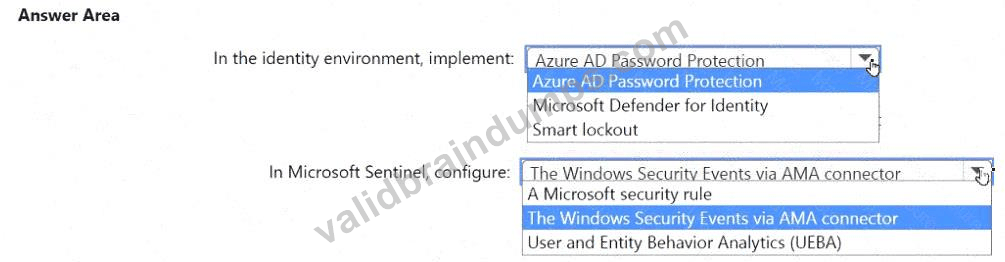
Correct Answer:
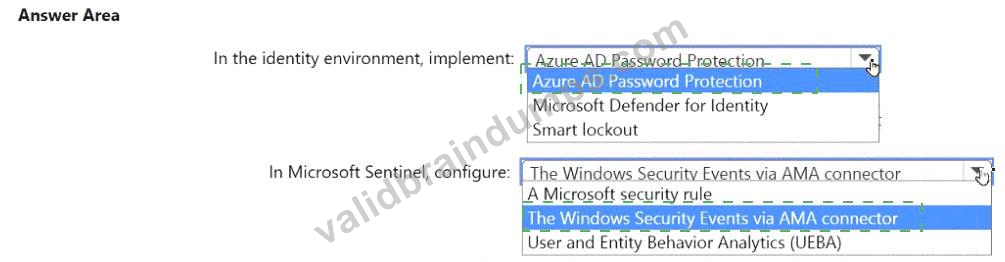
Explanation:
To monitor and detect higher-than-normal volumes of password resets, you need to gather password reset event data both from Azure Active Directory (cloud identities) and from on-premises Active Directory (domain accounts). Microsoft's official Defender XDR and Sentinel integration guidance describes that:
Azure AD Password Protection enforces and monitors password policies in both cloud and hybrid environments. It can detect weak, commonly used, or compromised passwords and logs related password change/reset activities. Deploying Azure AD Password Protection extends password reset visibility to on- premises domain controllers through the Password Protection proxy and DC agent. This makes it the correct choice for implementing monitoring at the identity environment level.
In Microsoft Sentinel, to ingest and analyze password reset activities from on-premises servers (e.g., domain controllers), you must use the Windows Security Events via AMA connector. This connector collects Event ID 4723 (password change), 4724 (password reset), and related security logs directly from Windows Servers into the Sentinel Log Analytics workspace through the Azure Monitor Agent (AMA). Once the events are available in Sentinel, they can be correlated with other identity or behavioral analytics to detect abnormal reset volumes or potential compromise attempts.
The other options are not suitable:
Microsoft Defender for Identity focuses on identity compromise detection, not specifically on password reset volume monitoring.
Smart lockout protects against brute-force sign-in attempts but doesn't generate detailed reset event telemetry.
Microsoft security rule and UEBA are higher-level analytic configurations, not data ingestion mechanisms.
Therefore, to meet the Sentinel requirements for monitoring password reset anomalies:
# Implement in the identity environment: Azure AD Password Protection
# Configure in Microsoft Sentinel: The Windows Security Events via AMA connector
You have a Microsoft Sentinel workspace named Workspacel that contains a table named CommonSecurityLog. You ingest logs into CommonSecurityLog. CommonSecurityLog has an average log ingestion time of five minutes.
You need to create an analytics rule that has a lookback period of seven minutes and uses the data in the CommonSecurityLog table. The solution must meet the following requirements:
* Prevent the same event from being processed twice.
* Minimize the number of missed events due to log ingestion delays.
How should you complete the KQL query that defines the rule? To answer, select the appropriate options in the answer area.
NOTE: Each correct selection is worth one point.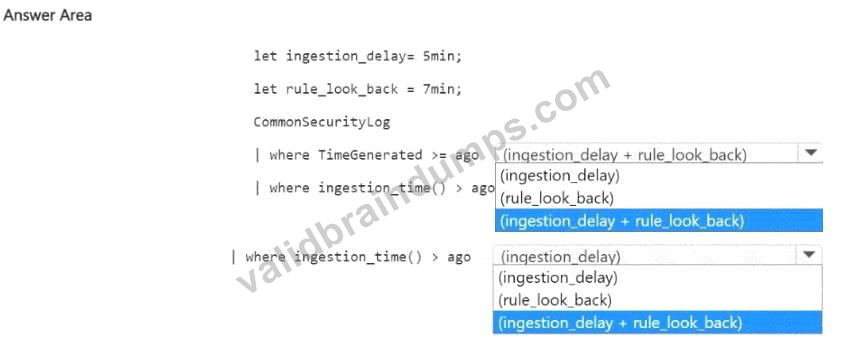
Correct Answer:
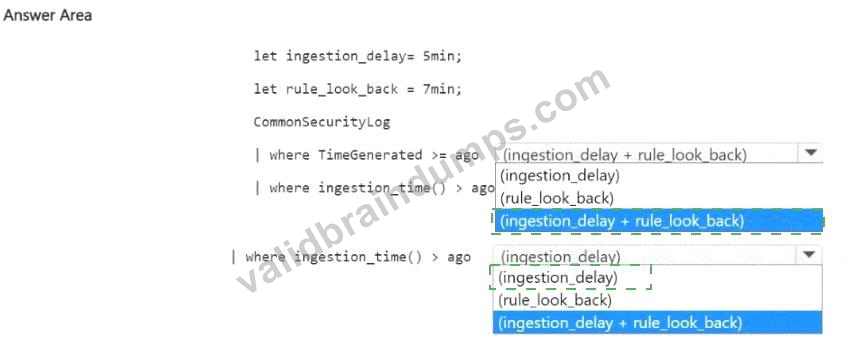
Explanation: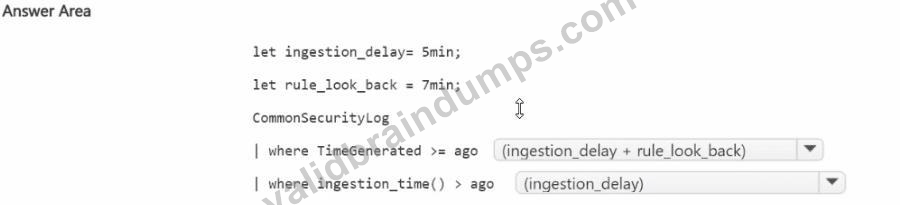
When creating scheduled analytics rules in Microsoft Sentinel, you should account for ingestion delay so late- arriving events aren't missed, while also avoiding reprocessing the same events. The recommended pattern is to widen the TimeGenerated window by the expected delay and then gate results by ingestion_time() to include only data that actually arrived within the delay window:
let ingestion_delay = 5min;
let rule_look_back = 7min;
CommonSecurityLog
| where TimeGenerated > = ago(ingestion_delay + rule_look_back) // cover late arrivals
| where ingestion_time() > ago(ingestion_delay) // only newly ingested data TimeGenerated > = ago(ingestion_delay + rule_look_back) ensures the query looks back 7 + 5 = 12 minutes, so events that were generated up to 7 minutes ago but arrived up to 5 minutes late are still captured.
ingestion_time() > ago(ingestion_delay) limits results to items ingested in the last 5 minutes, preventing the same already-processed events from being picked up again on the next run, while minimizing misses due to late ingestion.
Thus, choose (ingestion_delay + rule_look_back) for the first blank and (ingestion_delay) for the second.
You manage the security posture of an Azure subscription that contains two virtual machines name vm1 and vm2.
The secure score in Azure Security Center is shown in the Security Center exhibit. (Click the Security Center tab.)
Azure Policy assignments are configured as shown in the Policies exhibit. (Click the Policies tab.)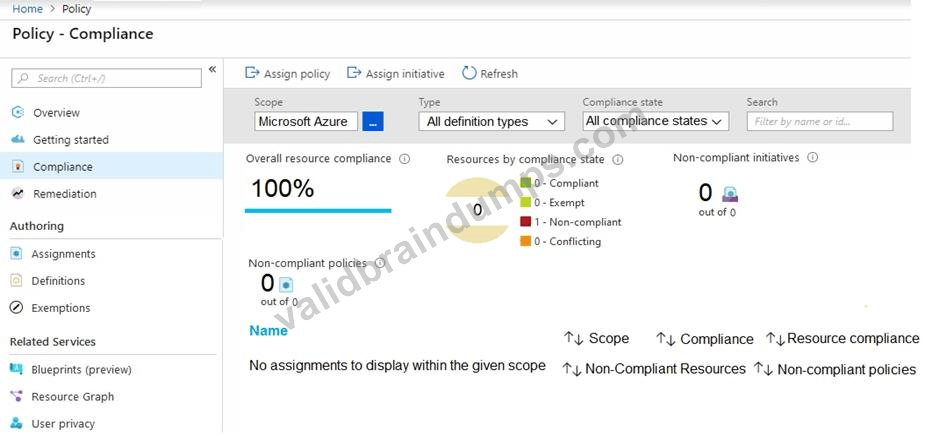
For each of the following statements, select Yes if the statement is true. Otherwise, select No.
NOTE: Each correct selection is worth one point.
Correct Answer:
Explanation:
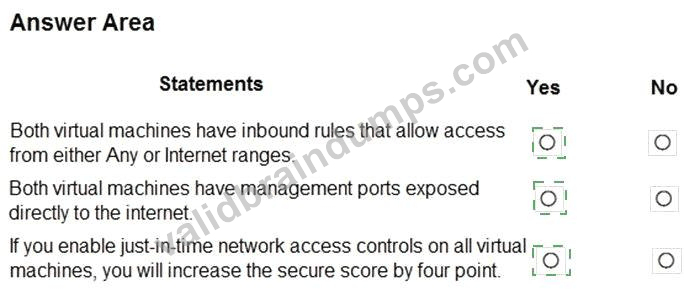
Statements
Answer
Both virtual machines have inbound rules that allow access from either Any or Internet ranges.
Yes
Both virtual machines have management ports exposed directly to the internet.
Yes
If you enable just-in-time network access controls on all virtual machines, you will increase the secure score by four points.
Yes
In the Microsoft Defender for Cloud (Azure Security Center) screenshot, the Secure Score report shows several active security recommendations, including:
"Restrict unauthorized network access" with a potential score increase of +9% (4 points) for 2 of 2 resources.
"Secure management ports" with a potential score increase of +9% (4 points) for 1 of 2 resources.
These controls correspond to Defender for Cloud recommendations related to network security and exposure of management ports (RDP/SSH). The fact that both controls show "2 of 2 resources" or "1 of 2 resources" as unhealthy means both virtual machines currently have NSG or firewall rules that allow inbound access from
"Any" or "Internet ranges," indicating open ports and insecure configurations.
According to Microsoft documentation ("Improve your Secure Score in Microsoft Defender for Cloud"), enabling Just-In-Time (JIT) VM access mitigates these findings by restricting inbound RDP/SSH access to approved users for limited time windows, thereby increasing the Secure Score. Each remediated recommendation increases the Secure Score by the number of points shown in the "Potential score increase" column (4 points in this case).
Because Azure Policy shows no assigned or conflicting policies, compliance enforcement is not yet active, confirming that the current exposure is due to lack of configuration rather than policy override.
Therefore:
The two VMs have inbound Internet-accessible rules # Yes.
They have management ports exposed # Yes.
Enabling JIT network access would fix both recommendations, improving the Secure Score by 4 points # Yes.
You have a Microsoft 365 E5 subscription that uses Microsoft Defender XDR and contains a Windows device named Device1.
You detect malicious activity on Device1.
You initiate a live response session on Device1.
You need to perform the following actions:
* Download a file from the live response library.
* Stop a process that is running on Device1.
Which live response command should you run for each action? To answer, select the appropriate options in the answer area.
NOTE: Each correct selection is worth one point.
Correct Answer:

Explanation:
In Microsoft Defender for Endpoint live response sessions, specific commands are provided to perform investigation and remediation tasks directly on a device. According to the official Defender for Endpoint documentation:
The getfile command is used to download a file from the live response library to the local analyst's session.
This command enables investigators to retrieve files that are stored in the Defender live response library for examination or comparison. The command is explicitly documented as "Retrieves a file from the library or from the device." The remediate command is used to take action against threats detected on the endpoint, such as stopping processes, deleting files, or quarantining malware. The remediation commands are part of the live response toolkit and provide direct control over running processes or malicious files during an active incident response session.
Other commands serve different purposes:
library lists the available files in the live response library.
putfile uploads files to the library.
analyze runs advanced analysis tasks.
services lists or manages Windows services but is not used to stop arbitrary processes.
Therefore, for this scenario, the correct live response commands are:
Download a file from the live response library: getfile
Stop a process that is running on Device1: remediate
You have an Azure subscription that contains a Microsoft Sentinel workspace named WS1.
You create a hunting query that detects a new attack vector. The attack vector maps to a tactic listed in the MITRE ATT & CK database.
You need to ensure that an incident is created in WS1 when the new attack vector is detected.
What should you configure?
Correct Answer: C 🗳️
Explanation: Only visible for ValidBraindumps members. You can sign-up / login (it's free).
Viewing page 1 out of 83 pages.
Viewing questions 1-5 out of 415 questions.
Over 61842+ Satisfied Customers
Thanks for SC-200 practice dumps. They are accurate and valid.
Roderick
ValidBraindumps is the perfect teacher. When I started studying for the SC-200 exam I had many confusions about the pattern and most importantly what was expected by me. Thanks!
 Hilary
I had a month old SC-200 exam dump but it's still valid. I passed SC-200 exam and received my certification.
 Peter
Peter
Thanks again!
I decide to get Certification Microsoft Certified: Security Operations Analyst Associate.
 Faithe
You provided SC-200 guaranteed success option in this matter.
 Malcolm
When I purchased the SC-200 exam questions, I expected the SC-200 exam questions to be up-to-date. And they are exactly what i need for my preparation! I passed the SC-200 exam successfully. Thanks!
 Mavis
Mavis
All my thanks to SC-200 study material.
 Boyd
Boyd
Unbelievable!
Finally get the real questions of this SC-200 exam.
 Harley
The dumps are very useful. Made it through the exam 1st try. The Questions are pretty close to the real exam questions.
 Samantha
This SC-200 exam dump can give you the right guidance to passs this exam. Guys, you can just study hard on them and pass!
 Kerr
Kerr
Highly suggested exam dumps at ValidBraindumps for SC-200. I studied from these and passed my exam yesterday with a great score.
 Sabrina
This SC-200 practice test is truly an exam savior! I cleared my exam easily only with it. Thanks!
 Lucy
Lucy
Passed the actual exam to share with you the experience..SC-200 braindumps works perfect makes me pass the exam.
 Osborn
I highly recommend to all of you this SC-200 exam dumps. I got a high passing score with this dump.
 Jerome
I have a lot of work to do, but i still want to have a SC-200 certification. Your SC-200 exam braindumps helped me achieve it today. Big thanks!
 Lou
Lou
We respect customer privacy. We use McAfee's security service to provide you with utmost security for your personal information & peace of mind.
Free update is available within 365 days after your purchase. After 365 days, you will get 50% discounts for updating.
Full refund if you fail the corresponding exam in 60 days after purchasing. And Free get any another product.
After Payment, our system will send you the products you purchase in mailbox in a minute after payment. If not received within 2 hours, please contact us.


