

Latest 350-401 Pass Guaranteed Exam Dumps with Accurate & Updated Questions
350-401 Exam Brain Dumps - Study Notes and Theory
NEW QUESTION # 400
Drag anti drop the characteristics from the ten onto the configuration models on the right.
Answer:
Explanation:
NEW QUESTION # 401
Drag and drop the snippets onto the blanks within the code to construct a script that configures BGP according to the topology. Not all options are used, and some options may be used twice.
Answer:
Explanation:
Explanation
Graphical user interface, text, application, email Description automatically generated
NEW QUESTION # 402
Which technology is used to provide Layer 2 and Layer 3 logical networks in the Cisco SD-Access architecture?
- A. underlay network
- B. easy virtual network
- C. VPN routing/forwarding
- D. overlay network
Answer: D
Explanation:
NEW QUESTION # 403
Which function does a fabric AP perform in a Cisco SD-Access deployment?
- A. It manages wireless clients' membership information in the fabric
- B. It updates wireless clients' locations in the fabric
- C. It configures security policies down to wireless clients in the fabric
- D. It connects wireless clients to the fabric.
Answer: B
NEW QUESTION # 404
Refer to the exhibit.
An engineer configures monitoring on SW1 and enters the show command to verify operation. What does the output confirm?
- A. SPAN session 1 monitors activity on VLAN 50 of a remote switch
- B. RSPAN session 1 is incompletely configured for monitoring
- C. SPAN session 2 only monitors egress traffic exiting port FastEthernet 0/14.
- D. SPAN session 2 monitors all traffic entering and exiting port FastEthernet 0/15.
Answer: B
Explanation:
SW1 has been configured with the following commands:
SW1(config)#monitor session 1 source remote vlan 50 SW1(config)#monitor session 2 source interface fa0/14 SW1(config)#monitor session 2 destination interface fa0/15
The session 1 on SW1 was configured for Remote SPAN (RSPAN) while session 2 was configured for local SPAN. For RSPAN we need to configure the destination port to complete the configuration.
Note: In fact we cannot create such a session like session 1 because if we only configure ―Source RSPAN VLAN 50‖ (with the command ―monitor session 1 source remote vlan 50‖) then we will receive a ―Type: Remote Source Session‖ (not ―Remote Destination Session‖).
NEW QUESTION # 405
What is the difference between CEF and process switching?
- A. CEF is more CPU-intensive than process switching.
- B. CEF processes packets that are too complex for process switching to manage.
- C. CEF uses the FIB and the adjacency table to make forwarding decisions, whereas process switching punts each packet.
- D. Process switching is faster than CEF.
Answer: C
Explanation:
NEW QUESTION # 406
What is the purpose of the LISP routing and addressing architecture?
- A. It allows multiple Instances of a routing table to co-exist within the same router.
- B. It creates two entries for each network node, one for Its identity and another for its location on the network.
- C. It allows LISP to be applied as a network visualization overlay though encapsulation.
- D. It creates head-end replication used to deliver broadcast and multicast frames to the entire network.
Answer: B
NEW QUESTION # 407
Refer to me exhibit.
Refer to the exhibit. Traffic is not passing between SW1 and SW2. Which action fixes the issue?
- A. Configure LACP mode on S1 to active.
- B. Configure LACP mode on S1 to passive.
- C. Configure switch port mode to ISL on S2.
- D. Configure PAgP mode on S1 to desirable.
Answer: D
NEW QUESTION # 408
Which statement describes the IP and MAC allocation requirements for virtual machines on types 1 hypervisors?
- A. Each virtual machine requires a unique IP and MAC addresses to be able to reach to other nodes.
- B. Each virtual machine requires a unique IP address but shares the MAC address with the physical server
- C. Each virtual machines requires a unique IP address but shares the MAC address with the address of the physical server.
- D. Each virtual machine requires a unique MAC address but shares the IP address with the physical server.
Answer: A
Explanation:
Explanation
A virtual machine (VM) is a software emulation of a physical server with an operating system.
From an application's point of view, the VM provides the look
and feel of a real physical server, including all its components, such as CPU, memory, and network interface cards (NICs).
The virtualization software that creates VMs and performs the hardware abstraction that allows multiple VMs to run concurrently is known as a hypervisor.
There are two types of hypervisors: type 1 and type 2 hypervisor.
In type 1 hypervisor (or native hypervisor), the hypervisor is installed directly on the physical server. Then instances of an operating system (OS) are installed on the hypervisor. Type 1 hypervisor has direct access to the hardware resources. Therefore they are more efficient than hosted architectures. Some examples of type 1 hypervisor are VMware vSphere/ESXi, Oracle VM Server, KVM and Microsoft Hyper-V.
In contrast to type 1 hypervisor, a type 2 hypervisor (or hosted hypervisor) runs on top of an operating system and not the physical hardware directly. answer 'Each virtual machine requires a unique IP and MAC addresses to be able to reach to other nodes' big advantage of Type 2 hypervisors is that management console software is not required. Examples of type 2 hypervisor are VMware Workstation (which can run on Windows, Mac and Linux) or Microsoft Virtual PC (only runs on Windows).
NEW QUESTION # 409
Drag and drop the tools from the left onto the agent types on the right.
Answer:
Explanation:
NEW QUESTION # 410
Refer to the exhibit.
How should the script be completed so that each device configuration is saved into a JSON-formatted file under the device name?
- A.

- B.

- C.

- D.

Answer: C
NEW QUESTION # 411
A network engineer configures BGP between R1 and R2. Both routers use BGP peer group CORP and are set up to use MD5 authentication. This message is logged to the console of router R1:
- A. Option C
- B. Option E
- C. Option B
- D. Option A
- E. Option D
Answer: B,C
NEW QUESTION # 412
Refer to the exhibit.
An engineer configures routing between all routers and must build a configuration to connect R1 to R3 via a GRE tunnel Which configuration must be applied?
A)
B)
C)
D)
- A. Option B
- B. Option D
- C. Option C
- D. Option A
Answer: B
NEW QUESTION # 413
Drag and drop the virtual components from the left onto their deceptions on the right.
Answer:
Explanation:
NEW QUESTION # 414
What does the number in an NTP stratum level represent?
- A. The amount of drift between the device clock and true time.
- B. The number of hops it takes to reach the master time server.
- C. The number of hops it takes to reach the authoritative time source.
- D. The amount of offset between the device clock and true time.
Answer: C
NEW QUESTION # 415
What occurs when a high bandwidth multicast stream is sent over an MVPN using Cisco hardware?
- A. A data MDT is created to allow for the best transmission through the core for (S, G) multicast route entries.
- B. A data MDT is created to if it is a (*, G) multicast route entries
- C. A data and default MDT are created to flood the multicast stream out of all PIM-SM neighbors.
- D. The traffic uses the default MDT to transmit the data only if it isa (S,G) multicast route entry
Answer: B
NEW QUESTION # 416
Drag and drop the Qos mechanisms from the left to the correct descriptions on the right
Answer:
Explanation:
Explanation
NEW QUESTION # 417
Simulation 06
Refer to me exhibit.

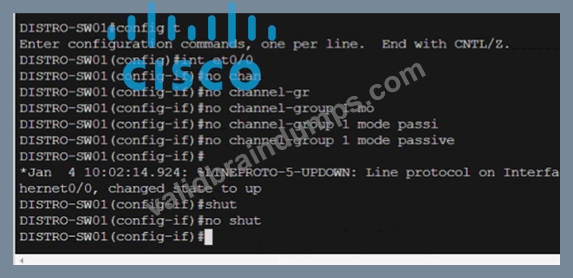

Answer:
Explanation:
Distro-Switch1
Int et0/0
No Channel-group 1 mode passive
Int range et0/2-3
No Channel-group 1 mode passive
Channel-group 1 mode active
Shut
No shut
Int port 1
Switchport trunk native vlan 10
Copy run start
Distro-Switch2
Int port 1
Switchport trunk native vlan 10
Copy run start
Distro-Switch2
Spanning-tree vlan 1-1005 root secondary
Copy run start
NEW QUESTION # 418
Refer to the exhibit. Which configuration change will force BR2 to reach 209 165 201 0/27 via BR1?
- A. Set the local preference to 150 on PE1 toward BR1 outbound
- B. Set the origin to igp on BR2 toward PE2 inbound.
- C. Set the weight attribute to 65.535 on BR1 toward PE1.
- D. Set the MED to 1 on PE2 toward BR2 outbound.
Answer: D
Explanation:
NEW QUESTION # 419
Drag and drop the REST API authentication methods from the left onto their descriptions on the right.
Answer:
Explanation:
Explanation
Graphical user interface, application Description automatically generated with medium confidence
NEW QUESTION # 420
Drag and drop the LISP components from the left onto the function they perform on the right. Not all options are used.
Answer:
Explanation:
NEW QUESTION # 421
What are two features of NetFlow flow monitoring? (Choose two.)
- A. Can track ingress and egress information
- B. Does not required packet sampling on interfaces
- C. Copies all ingress flow information to an interface
- D. Include the flow record and the flow importer
- E. Can be used to track multicast, MPLS, or bridged traffic.
Answer: A,E
Explanation:
The following are restrictions for Flexible NetFlow: + Traditional NetFlow (TNF) accounting is not supported. + Flexible NetFlow v5 export format is not supported, only NetFlow v9 export format is supported. + Both ingress and egress NetFlow accounting is supported. + Microflow policing feature shares the NetFlow hardware resource with FNF. + Only one flow monitor per interface and per direction is supported.
Reference:
When configuring NetFlow, follow these guidelines and restrictions:
+ Except in PFC3A mode, NetFlow supports bridged IP traffic. PFC3A mode does not support NetFlow bridged IP traffic. + NetFlow supports multicast IP traffic.
The Flexible NetFlow - MPLS Egress NetFlow feature allows you to capture IP flow information for packets that arrive on a router as Multiprotocol Label Switching (MPLS) packets and are transmitted as IP packets. This feature allows you to capture the MPLS VPN IP flows that are traveling through the service provider backbone from one site of a VPN to another site of the same VPN
NEW QUESTION # 422
......
Pass Cisco 350-401 Test Practice Test Questions Exam Dumps: https://examsboost.validbraindumps.com/350-401-exam-prep.html