

Maximum Grades By Making ready With SPLK-2003 Dumps UPDATED 2024
Prepare SPLK-2003 Exam Questions [2024] Recently Updated Questions
The Splunk Phantom Certified Admin certification is ideal for IT professionals who want to enhance their skills in Splunk Phantom and its administration. It is also suitable for security analysts, SOC analysts, incident responders, and IT administrators who want to automate their security operations and improve their overall security posture. Splunk Phantom Certified Admin certification is recognized globally and is highly valued by employers.
The SPLK-2003: Splunk Phantom Certified Admin exam is an important certification program for IT professionals who have experience in security automation and orchestration. SPLK-2003 exam is designed to validate the knowledge and skills of candidates in the areas of Phantom platform administration, automation design, and incident response management. Successful candidates will be able to demonstrate their ability to effectively use the Phantom platform to automate security tasks and manage security incidents.
Earning the Splunk Phantom Certified Admin certification can provide numerous benefits to professionals in the cybersecurity and IT operations fields. Certified individuals have a deep understanding of the Splunk Phantom platform and are equipped with the knowledge and skills to effectively manage security operations and incident response processes. They are highly sought after by organizations that want to enhance their cybersecurity posture and improve their incident response capabilities. Additionally, certified individuals can benefit from greater job opportunities and higher salaries.
NEW QUESTION # 12
A user wants to use their Splunk Cloud instance as the external Splunk instance for Phantom. What ports need to be opened on the Splunk Cloud instance to facilitate this? Assume default ports are in use.
- A. TCP 8080 and TCP 8191.
- B. TCP 80 and TCP 443.
- C. Splunk Cloud is not supported.
- D. TCP 8088 and TCP 8099.
Answer: A
NEW QUESTION # 13
An active playbook can be configured to operate on all containers that share which attribute?
- A. Label
- B. Artifact
- C. Tag
- D. Severity
Answer: A
NEW QUESTION # 14
Seventy can be set during ingestion and later changed manually. What other mechanism can change the severity or a container?
- A. Service level agreement (SLA) expiration
- B. Playbooks
- C. Notes
- D. Actions
Answer: B
Explanation:
The severity of a container in Splunk Phantom can be set manually or automatically during the ingestion process. In addition to these methods, playbooks can also change the severity of a container. Playbooks are automated workflows that define a series of actions based on certain triggers and conditions. Within a playbook, actions can be defined to adjust the severity level of a container depending on the analysis of the event data, the outcome of actions taken, or other contextual factors. This dynamic adjustment allows for a more accurate and responsive incident prioritization as new information becomes available during the investigation process.
NEW QUESTION # 15
Which of the following will show all artifacts that have the term results in a filePath CEF value?
- A. .../result/artifacts/cef/filePath= '%results%''
- B. ...rest/artifacts/filePath=''%results%''
- C. .../result/artifact?_query_cef_filepath_icontains=''results
- D. .../rest/artifact?_filter_cef_filePath_icontain=''results''
Answer: C
NEW QUESTION # 16
Which of the following describes the use of labels in Phantom?
- A. Labels control which apps are allowed to execute actions on the container.
- B. Labels control the default seventy, ownership, and sensitivity for the container.
- C. Labels determine the service level agreement (SLA) for a container.
- D. Labels determine which playbook(s) are executed when a container is created.
Answer: D
Explanation:
In Splunk Phantom, labels are used to categorize containers and trigger specific automated responses. When a container is created, labels can be assigned to it based on the nature of the event, type of incident, or other criteria. These labels are then matched against playbooks, which have label conditions defined within them.
When the conditions are met, the corresponding playbooks are automatically executed. Labels do not directly control service level agreements, default severity, ownership, sensitivity, or app execution permissions.
NEW QUESTION # 17
Some of the playbooks on the Phantom server should only be executed by members of the admin role. How can this rule be applied?
- A. Make sure the Execute Playbook capability is removed from al roles except admin.
- B. Add a filter block to al restricted playbooks that Titters for runRole - "Admin''.
- C. Place restricted playbooks in a second source repository that has restricted access.
- D. Add a tag with restricted access to the restricted playbooks.
Answer: B
NEW QUESTION # 18
Which Phantom VPE Nock S used to add information to custom lists?
- A. API blocks
- B. Decision blocks
- C. Action blocks
- D. Filter blocks
Answer: D
Explanation:
Explanation
Filter blocks are used to add information to custom lists in Phantom VPE. Filter blocks allow the user to specify a list name and a filter expression to select the data to be added to the list. Action blocks are used to execute app actions, API blocks are used to make REST API calls, and decision blocks are used to evaluate conditions and branch the playbook execution. Reference, page 14.
NEW QUESTION # 19
How can the debug log for a playbook execution be viewed?
- A. Open the playbook in the Visual Playbook Editor, and select Debug Logs in Settings.
- B. In Administration > System Health > Playbook Run History, select the playbook execution entry, then select Log.
- C. On the Investigation page, select Debug Log from the playbook's action menu in the Recent Activity panel.
- D. Click Expand Scope m the debug window.
Answer: C
Explanation:
Debug logs are essential for troubleshooting and understanding the execution flow of a playbook in Splunk Phantom. The debug log for a playbook execution can be viewed by navigating to the Investigation page of a specific event or container. Within the Recent Activity panel, there is an action menu associated with each playbook run. Selecting "Debug Log" from this menu will display the detailed execution log, showing each action taken, the results of those actions, and any errors or messages generated during the playbook run.
NEW QUESTION # 20
How does a user determine which app actions are available?
- A. Add an action block to a playbook canvas area.
- B. Search the Apps category in the global search field.
- C. From the Apps menu, click the supported actions dropdown for each app.
- D. In the visual playbook editor, click Active and click the Available App Actions dropdown.
Answer: B
NEW QUESTION # 21
In this image, which container fields are searched for the text "Malware"?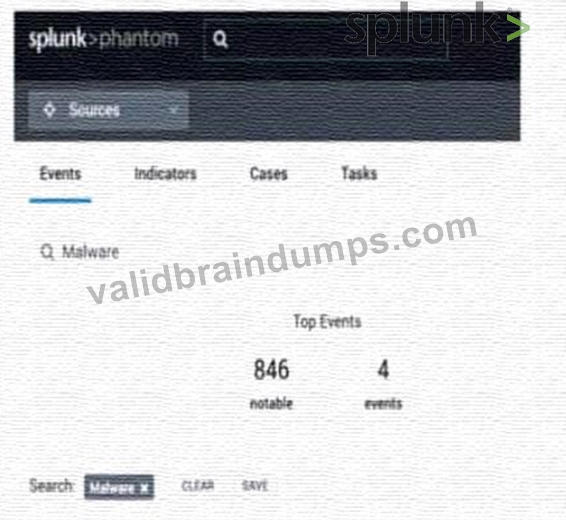
- A. Event Name or ID.
- B. Event Name and Artifact Names.
- C. Event Name, Notes, Comments.
Answer: B
Explanation:
The image shows a user interface of "splunk>phantom" with a search bar at the top, where a search for
"Malware" has been initiated. The tabs labeled "Events," "Indicators," "Cases," and "Tasks" suggest that the search functionality could span across various container fields within the Splunk SOAR environment.
Typically, the search would include fields that are most relevant to the user's query, which in this case, are likely to be the Event Name and Artifact Names. These fields are central to identifying and categorizing events and artifacts within Splunk SOAR, making them primary targets for a search term like "Malware" which is commonly associated with security events and indicators17.
References:
Understanding containers - Splunk Documentation
NEW QUESTION # 22
After a playbook has run, where are the results stored?
- A. Splunk Index
- B. Log file
- C. Container
- D. Case
Answer: C
Explanation:
The correct answer is C because after a playbook has run, the results are stored in the container that triggered the playbook. The container is a data object that represents an event or a case in Phantom. The container contains information such as the name, the description, the severity, the status, the owner, and the labels of the event or case. The container also contains the artifacts, the action results, the comments, the notes, and the phases and tasks associated with the event or case. The answer A is incorrect because after a playbook has run, the results are not stored in a Splunk index, which is a data structure that stores events from various data sources in Splunk. The Splunk index is not directly accessible by Phantom, but can be queried by Phantom using the Splunk app. The answer B is incorrect because after a playbook has run, the results are not stored in a case, which is a type of container that represents a security incident in Phantom. The case is a subset of the container, and not all containers are cases. The answer D is incorrect because after a playbook has run, the results are not stored in a log file, which is a file that records the activities or events that occur in a system or a process. The log file is not a data object in Phantom, but can be a data source for Phantom.
Reference: Splunk SOAR User Guide, page 19. In Splunk Phantom, after a playbook has been executed, the results of the actions within that playbook are stored in the container associated with the event. A container is a data structure that encapsulates all relevant information and data for an incident or event within Phantom, including action results, artifacts, notes, and more. The container allows users to see a consolidated view of all the data and activity related to a particular event. These results are not stored in the Splunk Index, a separate case, or a log file as their primary storage but may be sent to a Splunk index for further analysis.
NEW QUESTION # 23
Splunk user account(s) with which roles must be created to configure Phantom with an external Splunk Enterprise instance?
- A. phantomcreate. phantomedit
- B. superuser, administrator
- C. phantomsearch, phantomdelete
- D. admin,user
Answer: A
Explanation:
Explanation
The correct answer is B because Splunk user account(s) with the roles phantomcreate and phantomedit must be created to configure Phantom with an external Splunk Enterprise instance. These roles grant the necessary permissions to create and edit Phantom containers and artifacts from Splunk events. The superuser and administrator roles are not required for this integration. See Splunk SOAR Documentation for more details.
NEW QUESTION # 24
Configuring SOAR search to use an external Splunk server provides which of the following benefits?
- A. The ability to ingest Splunk notable events into SOAR.
- B. The ability to display results as Splunk dashboards within SOAR.
- C. The ability to run more complex reports on SOAR activities.
- D. The ability to automate Splunk searches within SOAR.
Answer: C
Explanation:
Configuring Splunk SOAR to use an external Splunk server provides several benefits, one of which is the ability to run more complex reports on SOAR activities. Splunk's powerful search and reporting capabilities allow for deeper analysis and more sophisticated reporting on the data generated by SOAR activities, beyond what is possible with the built-in SOAR search engine.
NEW QUESTION # 25
What is the primary objective of using the I2A2 playbook design methodology?
- A. To create simple, reusable, modular playbooks.
- B. To meet customer requirements using a single playbook.
- C. To create detailed playbooks.
- D. To create playbooks that customers will not edit.
Answer: A
Explanation:
The primary objective of using the I2A2 playbook design methodology in Splunk SOAR is to create playbooks that are simple, reusable, and modular. This design philosophy emphasizes the creation of playbooks that can be easily understood and maintained, encourages the reuse of playbook components in different scenarios, and fosters the development of playbooks that can be modularly connected or used independently as needed.
I2A2 design methodology is a framework for designing playbooks that consists of four components:
*Inputs: The data that is required for the playbook to run, such as artifacts, parameters, or custom fields.
*Interactions: The blocks that allow the playbook to communicate with users or other systems, such as prompts, comments, or emails.
*Actions: The blocks that execute the core logic of the playbook, such as app actions, filters, decisions, or utilities.
*Artifacts: The data that is generated or modified by the playbook, such as new artifacts, container fields, or notes.
The I2A2 design methodology helps you to plan, structure, and test your playbooks in a modular and efficient way. The primary objective of using the I2A2 design methodology is to create simple, reusable, modular playbooks that can be easily maintained, shared, and customized. Therefore, option D is the correct answer, as it states the primary objective of using the I2A2 design methodology. Option A is incorrect, because creating detailed playbooks is not the primary objective of using the I2A2 design methodology, but rather a possible outcome of following the framework. Option B is incorrect, because creating playbooks that customers will not edit is not the primary objective of using the I2A2 design methodology, but rather a potential risk of not following the framework. Option C is incorrect, because meeting customer requirements using a single playbook is not the primary objective of using the I2A2 design methodology, but rather a challenge that can be overcome by using the framework.
1: Use a playbook design methodology in Administer Splunk SOAR (Cloud).
NEW QUESTION # 26
Configuring Phantom search to use an external Splunk server provides which of the following benefits?
- A. The ability to automate Splunk searches within Phantom.
- B. The ability to ingest Splunk notable events into Phantom.
- C. The ability to display results as Splunk dashboards within Phantom.
- D. The ability to run more complex reports on Phantom activities.
Answer: A
Explanation:
The correct answer is C because configuring Phantom search to use an external Splunk server allows you to automate Splunk searches within Phantom using the run query action. This action can be used to run any Splunk search command on the external Splunk server and return the results to Phantom. You can also use the format results action to parse the results and use them in other blocks. See Splunk SOAR Documentation for more details.
Configuring Phantom (now known as Splunk SOAR) to use an external Splunk server enhances the automation capabilities within Phantom by allowing the execution of Splunk searches as part of the automation and orchestration processes. This integration facilitates the automation of tasks that involve querying data from Splunk, thereby streamlining security operations and incident response workflows.
Splunk SOAR's ability to integrate with over 300 third-party tools, including Splunk, supports a wide range of automatable actions, thus enabling a more efficient and effective security operations center (SOC) by reducing the time to respond to threats and by making repetitive tasks more manageable
https://www.splunk.com/en_us/products/splunk-security-orchestration-and-automation-features.html
NEW QUESTION # 27
What is enabled if the Logging option for a playbook's settings is enabled?
- A. The playbook will write detailed execution information into the spawn.log.
- B. All modifications to the playbook will be written to the audit log.
- C. More detailed information is available in the debug window.
- D. More detailed logging information Is available m the Investigation page.
Answer: C
Explanation:
Enabling the Logging option for a playbook's settings in Splunk SOAR enhances the level of detail provided in the debug window when the playbook is executed. This feature is particularly useful for development and troubleshooting purposes, as it allows playbook authors and analysts to see more granular information about how each action within the playbook operates, including inputs, outputs, and any errors or warnings. This detailed logging aids in identifying issues, understanding the playbook's flow, and optimizing performance.
NEW QUESTION # 28
A customer wants to design a modular and reusable set of playbooks that all communicate with each other.
Which of the following is a best practice for data sharing across playbooks?
- A. Use the Handle method to pass data directly between playbooks.
- B. Cal the child playbooks getter function.
- C. Create artifacts using one playbook and collect those artifacts in another playbook.
- D. Use the py-postgresq1 module to directly save the data in the Postgres database.
Answer: D
NEW QUESTION # 29
After enabling multi-tenancy, which of the Mowing is the first configuration step?
- A. Change the tenant permissions.
- B. Configure the default tenant.
- C. Select the associated tenant artifacts.
- D. Set default tenant base address.
Answer: B
Explanation:
Explanation
The correct answer is D because the first configuration step after enabling multi-tenancy is to configure the default tenant. Multi-tenancy is a feature that allows you to create multiple logical partitions of Phantom data and assets for different groups of users. The default tenant is the tenant that is created when Phantom is installed and contains all the existing data and assets. You need to configure the default tenant's name, description, base address, and logo before creating other tenants. See Splunk SOAR Documentation for more details.
NEW QUESTION # 30
Some of the playbooks on the Phantom server should only be executed by members of the admin role. How can this rule be applied?
- A. Add a filter block to al restricted playbooks that Titters for runRole - "Admin''.
- B. Place restricted playbooks in a second source repository that has restricted access.
- C. Add a tag with restricted access to the restricted playbooks.
- D. Make sure the Execute Playbook capability is removed from al roles except admin.
Answer: D
Explanation:
The correct answer is C because the best way to restrict the execution of playbooks to members of the admin role is to make sure the Execute Playbook capability is removed from all roles except admin. The Execute Playbook capability is a permission that allows a user to run any playbook on any container. By default, all roles have this capability, but it can be removed or added in the Phantom UI by going to Administration > User Management > Roles. Removing this capability from all roles except admin will ensure that only admin users can execute playbooks. See Splunk SOAR Documentation for more details. To ensure that only members of the admin role can execute specific playbooks on the Phantom server, the most effective approach is to manage role-based access controls (RBAC) directly. By configuring the system to remove the
"Execute Playbook" capability from all roles except for the admin role, you can enforce this rule. This method leverages Phantom's built-in RBAC mechanisms to restrict playbook execution privileges. It is a straightforward and secure way to ensure that only users with the necessary administrative privileges can initiate the execution of sensitive or critical playbooks, thus maintaining operational security and control.
NEW QUESTION # 31
......
Give push to your success with SPLK-2003 exam questions: https://examsboost.validbraindumps.com/SPLK-2003-exam-prep.html