

Microsoft AZ-305 Dumps Questions [2026] Pass for AZ-305 Exam
Updated Microsoft Study Guide AZ-305 Dumps Questions
NEW QUESTION # 195
Hotspot Question
You are designing an app that will be hosted on Azure virtual machines that run Ubuntu. The app will use a third-party email service to send email messages to users. The third-party email service requires that the app authenticate by using an API key.
You need to recommend an Azure Key Vault solution for storing and accessing the API key. The solution must minimize administrative effort.
What should you recommend using to store and access the key? To answer, select the appropriate options in the answer area.
NOTE: Each correct selection is worth one point.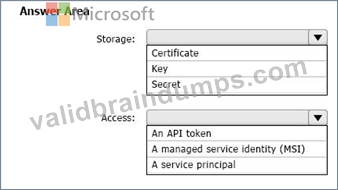
Answer:
Explanation:
Explanation:
Box 1: Secret
API keys are typically stored as secrets in Azure Key Vault. The key vault can store and manage secrets like API keys, passwords, or database connection strings.
Box 2: A managed service identity (MSI)
A managed service identity (MSI) is used to give your VM access to the key vault. The advantage of using MSI is that you do not have to manage credentials yourself. Azure takes care of rolling the credentials and ensuring their lifecycle. The application running on your VM can use its managed service identity to get a token to Azure AD, and then use that token to authenticate to Azure Key Vault.
NEW QUESTION # 196
You have an on-premises Microsoft SQL server named SQLI that hosts 50 databases.
You plan to migrate SQL 1 to Azure SQL Managed Instance.
You need to perform an offline migration of SQL 1. The solution must minimize administrative effort.
What should you include in the solution?
- A. Azure Database Migration Service
- B. SQL Server Migration Assistant (SSMA)
- C. Azure Migrate
- D. Data Migration Assistant (DMA)
Answer: A
Explanation:
Explanation
This Azure service supports migration in the offline mode for applications that can afford downtime during the migration process. Unlike the continuous migration in online mode, offline mode migration runs a one-time restore of a full database backup from the source to the target
https://learn.microsoft.com/en-us/azure/azure-sql/migration-guides/managed-instance/sql-server-to-managed-ins
NEW QUESTION # 197
Hotspot Question
You have an Azure subscription that is linked to an Azure Active Directory Premium Plan 2 tenant.
The tenant has multi-factor authentication (MFA) enabled for all users.
You have the named locations shown in the following table.
You have the users shown in the following table.
You plan to deploy the Conditional Access policies shown in the following table.
For each of the following statements, select Yes if the statement is true. Otherwise, select No.
NOTE: Each correct selection is worth one point.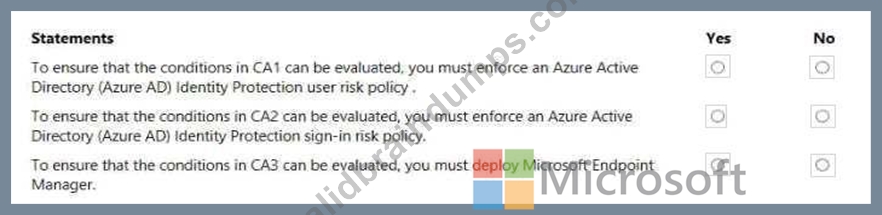
Answer:
Explanation: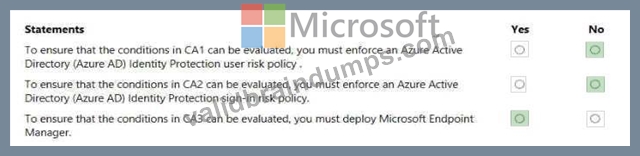
NEW QUESTION # 198
Hotspot Question
You plan to deploy Azure Databricks to support a machine learning application. Data engineers will mount an Azure Data Lake Storage account to the Databricks file system. Permissions to folders are granted directly to the data engineers.
You need to recommend a design for the planned Databrick deployment. The solution must meet the following requirements:
- Ensure that the data engineers can only access folders to which they
have permissions.
- Minimize development effort.
- Minimize costs.
What should you include in the recommendation? To answer, select the appropriate options in the answer area.
NOTE: Each correct selection is worth one point.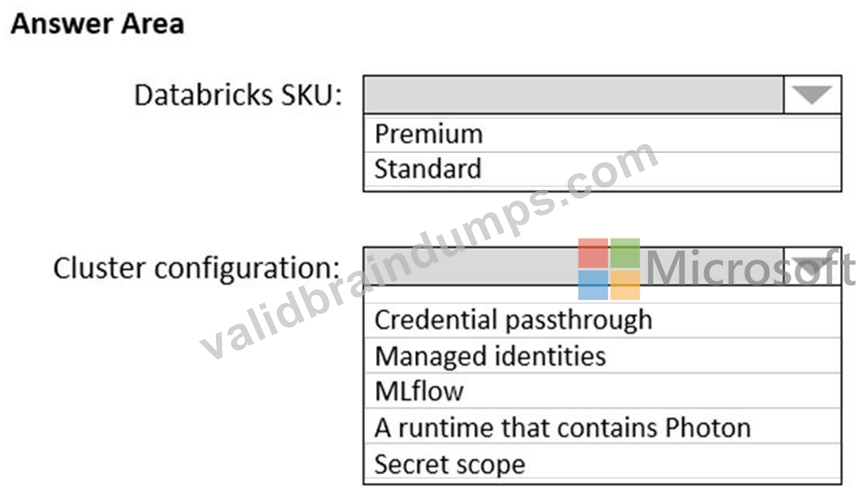
Answer:
Explanation:
Explanation:
Box 1: Premium
Standard clusters with credential passthrough are limited to a single user. Standard clusters support Python, SQL, Scala, and R.
On Databricks Runtime 6.0 and above, SparkR is supported; on Databricks Runtime 10.1 and above, sparklyr is supported.
Box 2: Credential passthrough
Athenticate automatically to Azure Data Lake Storage Gen1 (ADLS Gen1) and Azure Data Lake Storage Gen2 (ADLS Gen2) from Azure Databricks clusters using the same Azure Active Directory (Azure AD) identity that you use to log into Azure Databricks. When you enable Azure Data Lake Storage credential passthrough for your cluster, commands that you run on that cluster can read and write data in Azure Data Lake Storage without requiring you to configure service principal credentials for access to storage.
Reference:
https://docs.microsoft.com/en-us/azure/databricks/security/credential-passthrough/adls- passthrough
NEW QUESTION # 199
You plan to migrate App1 to Azure.
You need to estimate the compute costs for App1 in Azure. The solution must meet the security and compliance requirements.
What should you use to estimate the costs, and what should you implement to minimize the costs? To answer, select the appropriate options in the answer area.
NOTE: Each correct selection is worth one point.
Answer:
Explanation:
Explanation
Text Description automatically generated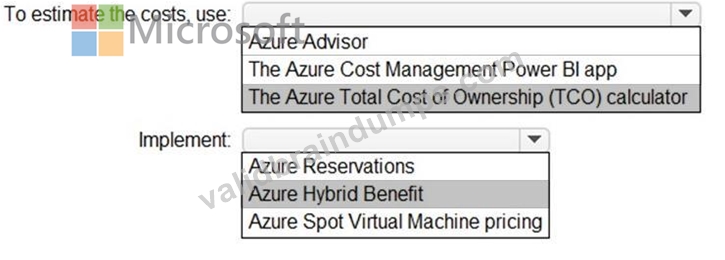
Box 1: The Azure Total Cost of Ownership (TCO) Calculator
The Total Cost of Ownership (TCO) Calculator estimates the cost savings you can realize by migrating your workloads to Azure.
Note: The TCO Calculator recommends a set of equivalent services in Azure that will support your applications. Our analysis will show each cost area with an estimate of your on-premises spend versus your spend in Azure. There are several cost categories that either decrease or go away completely when you move workloads to the cloud.
Box 2: Azure Hybrid Benefit
Azure Hybrid Benefit is a licensing benefit that helps you to significantly reduce the costs of running your workloads in the cloud. It works by letting you use your on-premises Software Assurance-enabled Windows Server and SQL Server licenses on Azure. And now, this benefit applies to RedHat and SUSE Linux subscriptions, too.
Scenario:
Litware identifies the following security and compliance requirements:
* Once App1 is migrated to Azure, you must ensure that new data can be written to the app, and the modification of new and existing data is prevented for a period of three years.
* On-premises users and services must be able to access the Azure Storage account that will host the data in App1.
* Access to the public endpoint of the Azure Storage account that will host the App1 data must be prevented.
* All Azure SQL databases in the production environment must have Transparent Data Encryption (TDE) enabled.
* App1 must not share physical hardware with other workloads.
Reference:
https://azure.microsoft.com/en-us/pricing/tco/
https://azure.microsoft.com/en-us/pricing/hybrid-benefit/
Topic 3, Contoso
Case Study
This is a case study. Case studies are not timed separately. You can use as much exam time as you would like to complete each case. However, there may be additional case studies and sections on this exam. You must manage your time to ensure that you are able to complete all questions included on this exam in the time provided.
To answer the questions included in a case study, you will need to reference information that is provided in the case study. Case studies might contain exhibits and other resources that provide more information about the scenario that is described in the case study. Each question is independent of the other questions in this case study.
At the end of this case study, a review screen will appear. This screen allows you to review your answers and to make changes before you move to the next section of the exam. After you begin a new section, you cannot return to this section.
To start the case study
To display the first question in this case study, click the Next button. Use the buttons in the left pane to explore the content of the case study before you answer the questions. Clicking these buttons displays information such as business requirements, existing environment, and problem statements. If the case study has an All Information tab, note that the information displayed is identical to the information displayed on the subsequent tabs. When you are ready to answer a question, click the Question button to return to the question.
Existing Environment: Technical Environment
The on-premises network contains a single Active Directory domain named contoso.com.
Contoso has a single Azure subscription.
Existing Environment: Business Partnerships
Contoso has a business partnership with Fabrikam, Inc. Fabrikam users access some Contoso applications over the internet by using Azure Active Directory (Azure AD) guest accounts.
Requirements: Planned Changes
Contoso plans to deploy two applications named App1 and App2 to Azure.
Requirements: App1
App1 will be a Python web app hosted in Azure App Service that requires a Linux runtime. Users from Contoso and Fabrikam will access App1.
App1 will access several services that require third-party credentials and access strings. The credentials and access strings are stored in Azure Key Vault.
App1 will have six instances: three in the East US Azure region and three in the West Europe Azure region.
App1 has the following data requirements:
* Each instance will write data to a data store in the same availability zone as the instance.
* Data written by any App1 instance must be visible to all App1 instances.
App1 will only be accessible from the internet. App1 has the following connection requirements:
* Connections to App1 must pass through a web application firewall (WAF).
* Connections to App1 must be active-active load balanced between instances.
* All connections to App1 from North America must be directed to the East US region. All other connections must be directed to the West Europe region.
Every hour, you will run a maintenance task by invoking a PowerShell script that copies files from all the App1 instances. The PowerShell script will run from a central location.
Requirements: App2
App2 will be a NET app hosted in App Service that requires a Windows runtime. App2 has the following file storage requirements:
* Save files to an Azure Storage account.
* Replicate files to an on-premises location.
* Ensure that on-premises clients can read the files over the LAN by using the SMB protocol.
You need to monitor App2 to analyze how long it takes to perform different transactions within the application. The solution must not require changes to the application code.
Application Development Requirements
Application developers will constantly develop new versions of App1 and App2. The development process must meet the following requirements:
* A staging instance of a new application version must be deployed to the application host before the new version is used in production.
* After testing the new version, the staging version of the application will replace the production version.
* The switch to the new application version from staging to production must occur without any downtime of the application.
Identity Requirements
Contoso identifies the following requirements for managing Fabrikam access to resources:
* Every month, an account manager at Fabrikam must review which Fabrikam users have access permissions to App1. Accounts that no longer need permissions must be removed as guests.
* The solution must minimize development effort.
Security Requirement
All secrets used by Azure services must be stored in Azure Key Vault.
Services that require credentials must have the credentials tied to the service instance. The credentials must NOT be shared between services.
NEW QUESTION # 200
You need to design a storage solution for an app that will store large amounts of frequently used dat a. The solution must meet the following requirements:
Maximize data throughput.
Prevent the modification of data for one year.
Minimize latency for read and write operations.
Which Azure Storage account type and storage service should you recommend? To answer, select the appropriate options in the answer area.
NOTE: Each correct selection is worth one point.
Answer:
Explanation:
Reference:
https://docs.microsoft.com/en-us/azure/storage/blobs/archive-blob
NEW QUESTION # 201
You are evaluating whether to use Azure Traffic Manager and Azure Application Gateway to meet the connection requirements for App1.
What is the minimum numbers of instances required for each service? To answer, select the appropriate options in the answer area.
NOTE: Each correct selection is worth one point.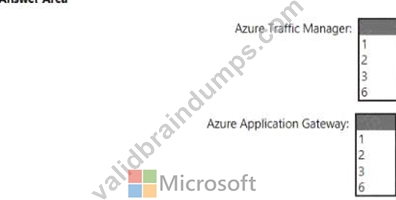
Answer:
Explanation:
Explanation
NEW QUESTION # 202
You have five .NET Core applications that run on 10 Azure virtual machines in the same subscription.
You need to recommend a solution to ensure that the applications can authenticate by using the same Azure Active Directory (Azure AD) identity. The solution must meet the following requirements:
Ensure that the applications can authenticate only when running on the 10 virtual machines.
Minimize administrative effort.
What should you include in the recommendation? To answer, select the appropriate options in the answer area.
NOTE: Each correct selection is worth one point.
Answer:
Explanation:
NEW QUESTION # 203
You are designing a data storage solution to support reporting.
The solution will ingest high volumes of data in the JSON format by using Azure Event Hubs. As the data arrives, Event Hubs will write the data to storage. The solution must meet the following requirements:
* Organize data in directories by date and time.
* Allow stored data to be queried directly, transformed into summarized tables, and then stored in a data warehouse.
* Ensure that the data warehouse can store 50 TB of relational data and support between 200 and 300 concurrent read operations.
Which service should you recommend for each type of data store? To answer, select the appropriate options in the answer area.
NOTE: Each correct selection is worth one point.
Answer:
Explanation:
Explanation
Graphical user interface, text, application, email Description automatically generated
NEW QUESTION # 204
You have 10 on-premises servers that run Windows Server.
You need to perform daily backups of the servers to a Recovery Services vault. The solution must meet the following requirements:
* Back up all the files and folders on the servers.
* Maintain three copies of the backups in Azure.
* Minimize costs.
What should you configure? To answer, select the appropriate options in the answer area.
NOTE: Each correct selection is worth one point.
Answer:
Explanation:
Explanation
NEW QUESTION # 205
You need to implement the Azure RBAC role assignment. The solution must meet the authentication and authorization requirements.
How many assignment should you configure for the Network Contributor role for Role1? To answer, select appropriate in the answer area.
NOTE:
Answer:
Explanation:
NEW QUESTION # 206
You plan to deploy the backup policy shown in the following exhibit.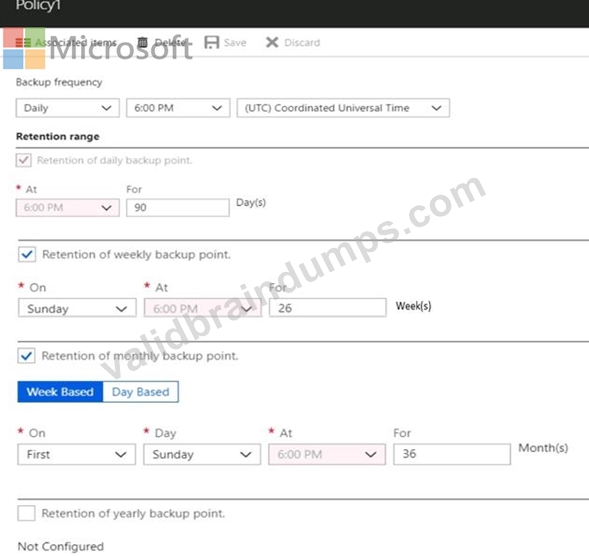
Use the drop-down menus to select the answer choice that completes each statement based on the information presented in the graphic.
NOTE: Each correct selection is worth one point.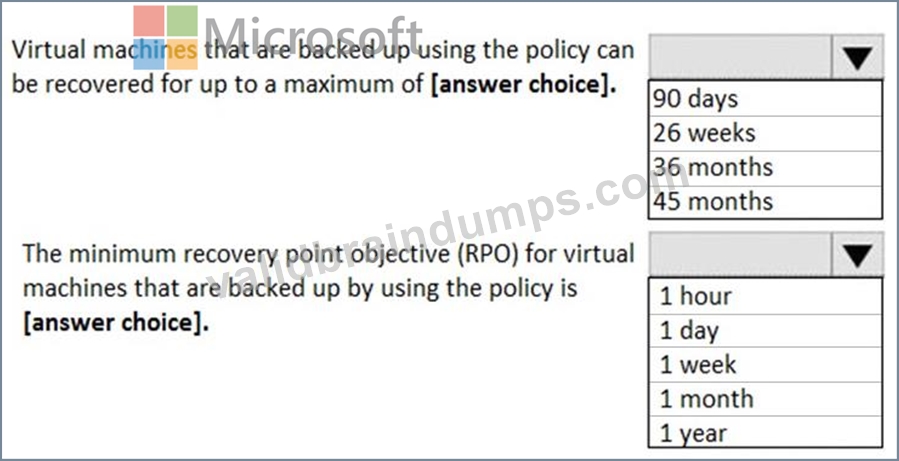
Answer:
Explanation:
NEW QUESTION # 207
You plan to migrate App1 to Azure.
You need to recommend a high-availability solution for App1. The solution must meet the resiliency requirements.
What should you include in the recommendation? To answer, select the appropriate options in the answer area.
NOTE: Each correct selection is worth one point.
Answer:
Explanation: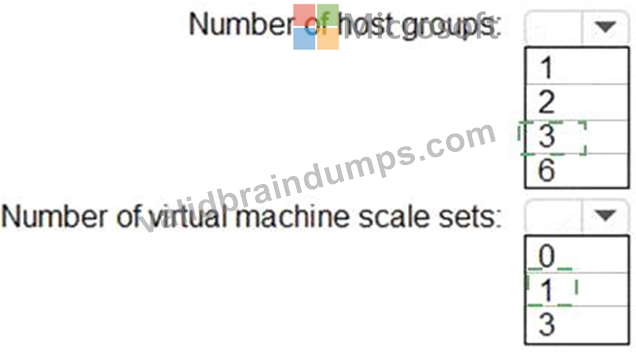
Explanation
Graphical user interface, text, application, email Description automatically generated
Box 1: 3
Scenario: App1 must meet the following requirements:
* Be hosted in an Azure region that supports availability zones.
* Maintain availability if two availability zones in the local Azure region fail.
A host group is a resource that represents a collection of dedicated hosts. You create a host group in a region and an availability zone, and add hosts to it.
Use Availability Zones for fault isolation
Availability zones are unique physical locations within an Azure region. Each zone is made up of one or more datacenters equipped with independent power, cooling, and networking. A host group is created in a single availability zone. Once created, all hosts will be placed within that zone. To achieve high availability across zones, you need to create multiple host groups (one per zone) and spread your hosts accordingly.
Box 2: 1
Scenario: App1 must meet the following requirements:
* Be hosted on Azure virtual machines that support automatic scaling.
An Azure virtual machine scale set can automatically increase or decrease the number of VM instances that run your application. This automated and elastic behavior reduces the management overhead to monitor and optimize the performance of your application.
Reference:
https://docs.microsoft.com/en-us/azure/virtual-machines/dedicated-hosts
https://docs.microsoft.com/en-us/azure/virtual-machine-scale-sets/virtual-machine-scale-sets-autoscale-overview
NEW QUESTION # 208
You have an Azure App Service web app that uses a system-assigned managed identity.
You need to recommend a solution to store their settings of the web app as secrets in an Azure key vault The solution must meet the following requirements:
* Minimize changes to the app code,
* Use the principle of least privilege.
What should you include in the recommendation? To answer, select the appropriate options in the answer area.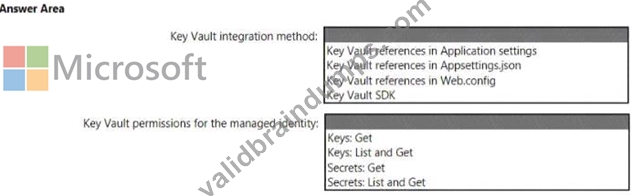
Answer:
Explanation:
Explanation
NEW QUESTION # 209
What should you recommend lo meet the monitoring requirements for App2?
- A. Container insights
- B. Azure Application Insights
- C. VM insights
- D. Microsoft Sentinel
Answer: B
Explanation:
An insurance company, HABInsurance, operates in three states and provides home, auto, and boat insurance. Besides the head office, HABInsurance has three regional offices.
NEW QUESTION # 210
Your on-premises network contains a file server named Server1 that stores 500 GB of data.
You need to use Azure Data Factory to copy the data from Server1 to Azure Storage.
You add a new data factory.
What should you do next? To answer, select the appropriate options in the answer area.
NOTE: Each correct selection is worth one point.
Answer:
Explanation:
Reference:
https://docs.microsoft.com/en-us/azure/machine-learning/team-data-science-process/move-sql-azure-adf
NEW QUESTION # 211
You plan to migrate App1 to Azure.
You need to estimate the compute costs for App1 in Azure. The solution must meet the security and compliance requirements.
What should you use to estimate the costs, and what should you implement to minimize the costs? To answer, select the appropriate options in the answer area.
NOTE: Each correct selection is worth one point.
Answer:
Explanation: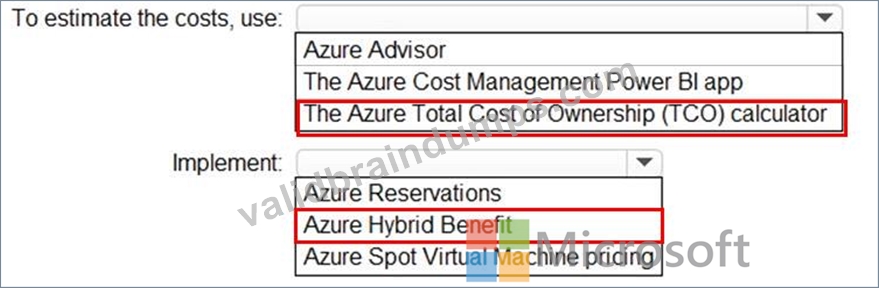
Reference:
https://azure.microsoft.com/en-us/pricing/tco/
https://azure.microsoft.com/en-us/pricing/hybrid-benefit/
NEW QUESTION # 212
You have an Azure web app named App1 and an Azure key vault named KV1.
App1 stores database connection strings in KV1.
App1 performs the following types of requests to KV1:
Get
List
Wrap
Delete
Unwrap
Backup
Decrypt
Encrypt
You are evaluating the continuity of service for App1.
You need to identify the following if the Azure region that hosts KV1 becomes unavailable:
To where will KV1 fail over?
During the failover, which request type will be unavailable?
What should you identify? To answer, select the appropriate options in the answer area.
NOTE: Each correct selection is worth one point.
Answer:
Explanation:
Reference:
https://docs.microsoft.com/en-us/azure/key-vault/general/disaster-recovery-guidance
NEW QUESTION # 213
You have an app named App1 that uses two on-premises Microsoft SQL Server databases named DB1 and DB2.
You plan to migrate DB1 and DB2 to Azure.
You need to recommend an Azure solution to host DB1 and DB2. The solution must meet the following requirements:
* Support server-side transactions across DB1 and DB2.
* Minimize administrative effort to update the solution.
What should you recommend?
- A. two Azure SQL databases on different Azure SQL Database servers
- B. two Azure SQL databases on the same Azure SQL Database managed instance
- C. two Azure SQL databases in an elastic pool
- D. two SQL Server databases on an Azure virtual machine
Answer: B
Explanation:
When both the database management system and client are under the same ownership (e.g. when SQL Server is deployed to a virtual machine), transactions are available and the lock duration can be controlled.
Reference: https://docs.particular.net/nservicebus/azure/understanding-transactionality-in-azure
NEW QUESTION # 214
You are designing an app that will include two components. The components will communicate by sending messages via a queue. You need to recommend a solution to process the messages by using a First in. First out (FIFO) pattern. What should you include in the recommendation?
- A. storage queues with a stored access policy
- B. storage queues with a custom metadata setting
- C. Azure Service Bus queues with partitioning enabled
- D. Azure Service Bus queues with sessions enabled
Answer: D
NEW QUESTION # 215
How should the migrated databases DB1 and DB2 be implemented in Azure?
Answer:
Explanation:
Explanation
Table Description automatically generated
Box 1: SQL Managed Instance
Scenario: Once migrated to Azure, DB1 and DB2 must meet the following requirements:
* Maintain availability if two availability zones in the local Azure region fail.
* Fail over automatically.
* Minimize I/O latency.
The auto-failover groups feature allows you to manage the replication and failover of a group of databases on a server or all databases in a managed instance to another region. It is a declarative abstraction on top of the existing active geo-replication feature, designed to simplify deployment and management of geo-replicated databases at scale. You can initiate a geo-failover manually or you can delegate it to the Azure service based on a user-defined policy. The latter option allows you to automatically recover multiple related databases in a secondary region after a catastrophic failure or other unplanned event that results in full or partial loss of the SQL Database or SQL Managed Instance availability in the primary region.
Box 2: Business critical
SQL Managed Instance is available in two service tiers:
General purpose: Designed for applications with typical performance and I/O latency requirements.
Business critical: Designed for applications with low I/O latency requirements and minimal impact of underlying maintenance operations on the workload.
Reference:
https://docs.microsoft.com/en-us/azure/azure-sql/database/auto-failover-group-overview
https://docs.microsoft.com/en-us/azure/azure-sql/managed-instance/sql-managed-instance-paas-overview
NEW QUESTION # 216
Hotspot Question
You have six Azure subscriptions in a management group. Each subscription contains two resource groups. Each resource group contains an Azure App Service instance. The App Service instances use app slots.
You need to perform the following actions on three of the subscriptions:
- Disable public network access for all the app slots.
- Assign tags to all the App Service instances.
The solution must meet the following requirements:
- Ensure that the App Service instances in the remaining subscriptions
are unaffected.
- Minimize administrative effort.
What is the minimum number of Azure Policy definitions and assignments required? To answer, select the appropriate options in the answer area.
Answer:
Explanation:
Explanation:
Box 1: 2
Policy definition 1: Disable public network access for all the app slots.
Policy definition 2: Assign tags to all the App Service instances.
Box 2: 1
Group the two policy definitions into a single policy initiative. For the policy initiative make one policy assignment with scope of the three subscriptions.
Note: Azure Policy evaluates resources and actions in Azure by comparing the properties of those resources to business rules. These business rules, described in JSON format, are known as policy definitions. To simplify management, several business rules can be grouped together to form a policy initiative (sometimes called a policySet). Once your business rules have been formed, the policy definition or initiative is assigned to any scope of resources that Azure supports, such as management groups, subscriptions, resource groups, or individual resources.
The assignment applies to all resources within the Resource Manager scope of that assignment.
Reference:
https://learn.microsoft.com/en-us/azure/governance/policy/overview
NEW QUESTION # 217
A company currently has an on-premise infrastructure that consists of:
- An Active Directory domain named lead2pass.com
- Active Directory Federation Services
- Application Proxy servers for external connection
The company has recently set up an Azure AD tenant and implemented Azure AD Connect to synchronize users from the on-premise AD to Azure AD. It has the following additional requirements:
- Ability to monitor the solutions that integrate with Azure AD
- Identify any potential issues in AD FS
- Identify any directory synchronization issues
Your task is to identify the proper monitoring solution for each type of server.
Which of the following would you use to monitor the AD Connect Servers?
- A. Active Directory Health Check solution in Azure Log Analytics
- B. Azure Security Center
- C. Active Directory Federation Services Health Check solution in Azure Log Analytics
- D. Azure AD Connect Health
Answer: D
Explanation:
The previous question asks to monitor AD FS servers whereas this question asks to monitor the AD Connect Servers.
Azure AD Connect Health has the ability to monitor all AD Connect Servers and check for any synchronization issues.
Businesses and organizations use the Azure AD Connect service to accomplish the hybrid identity goals. The service includes password hash synchronization, pass-through authentication, federation integration, synchronization, and health service monitoring. As an Azure administrator, you can monitor the health of the Azure AD Connect services by using the Azure AD Connect Health monitoring tools. Azure AD Connect Health portal presents alerts, performance monitoring, and usage analytics. The portal also provides insights into on-premises identity infrastructure.
You can review these options on the Azure Connect Health screen (Number 1). On the menu to the left, you have access to the information about the Azure AD Connect Sync services and errors (Number 2), monitoring of AD FS services (Number 3), and AD DS Services (Number 4).
For service health data collection, you must install the Azure AD Connect Health Agent on- premises (Number 5). Suppose the organization uses Active Directory Federation Services. In that case, you need to install Azure AD Connect Health Agent for AD FS or Azure AD Connect Health Agent for AD DS for Active Directory Domain Services.
Reference:
https://docs.microsoft.com/en-us/azure/active-directory/hybrid/whatis-azure-ad-connect
NEW QUESTION # 218
You have several Azure App Service web apps that use Azure Key Vault to store data encryption keys. Several departments have the following requests to support the web app:
Which service should you recommend for each department's request? To answer, configure the appropriate options in the answer area.
NOTE: Each correct selection is worth one point.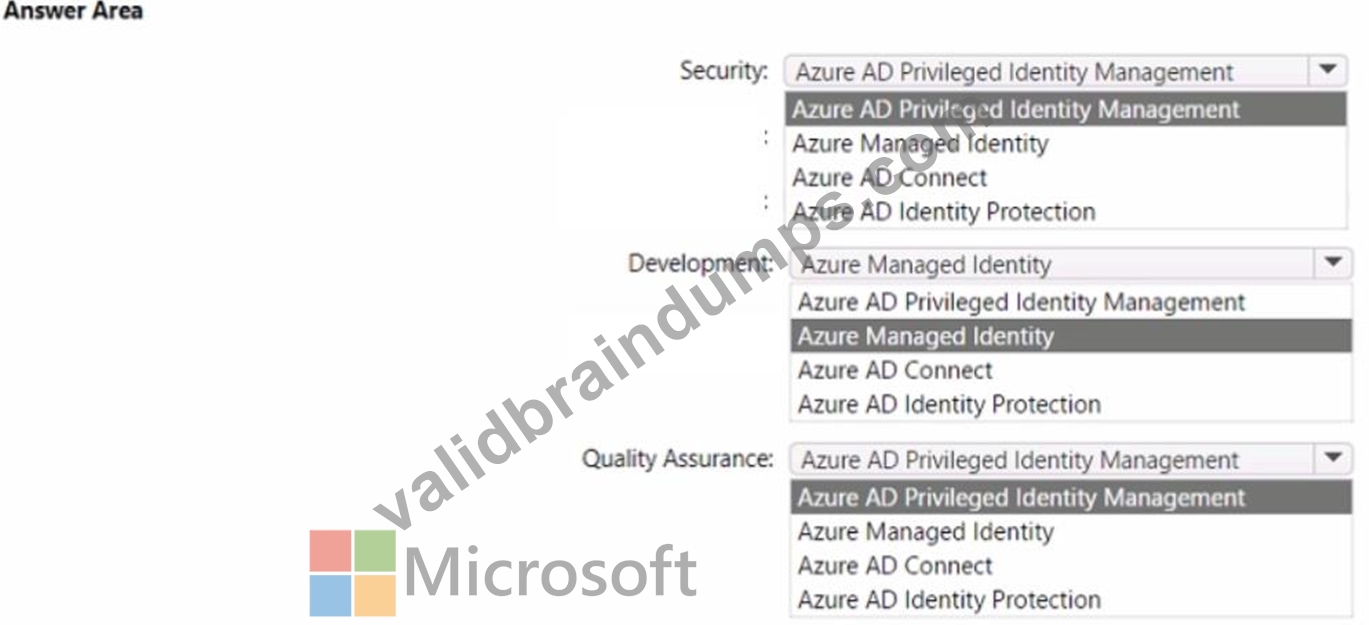
Answer:
Explanation:
NEW QUESTION # 219
......
Achieve Success in Actual AZ-305 Exam AZ-305 Exam Dumps: https://examsboost.validbraindumps.com/AZ-305-exam-prep.html