

Download Latest NCP-BC Dumps with Authentic Real Exam Questions
Authentic NCP-BC Exam Dumps PDF - Aug-2026 Updated
Nutanix NCP-BC Exam Syllabus Topics:
| Topic | Details |
|---|---|
| Topic 1 |
|
| Topic 2 |
|
| Topic 3 |
|
| Topic 4 |
|
NEW QUESTION # 60
An administrator configures disaster recovery between an on-premises AZ and a Nutanix Cloud AZ. The deployment follows the documented workflow, and no configuration errors are reported during setup.
After enabling DR and assigning protection policies to several VMs with volume groups, the administrator initiates failover and notices the VMs do not have their volume groups attached.
To troubleshoot, the administrator performs the following verification steps:
The clusters are successfully paired in Prism Central.
Protection policies and replication schedules are configured correctly.
Recovery plan validation completes successfully.
Required firewall ports between sites are confirmed open.
Management IP addresses are reachable in both directions.
Despite this, the administrator observes the volume groups are still not attached.
Which network-related prerequisite is most likely misconfigured?
- A. The recovery plan has not been validated.
- B. The clusters do not have a Data Services IP addresses configured.
- C. The hypervisor management interfaces are not on the same subnet.
- D. Nearsync replication does not support volume groups.
Answer: B
NEW QUESTION # 61
An administrator needs to provide leadership with a report showing the timeframe of each step during Recovery Plan failover testing.
How should the administrator produce this report?
- A. Review the built-in execution report from the test failover results.
- B. Use ncli on a CVM to query Recovery Plan execution history.
- C. Filter the Events log in Prism Central for Recovery Plan activity.
- D. Generate a custom report within Prism Central Intelligent Operations.
Answer: A
NEW QUESTION # 62
An administrator has received the following alert:
The administrator begins gathering troubleshooting information and determines the following: The VM has been replicating to this cluster successfully for at least 6 months The bandwidth has been sufficient to this point and hasn't caused an issue before Network connectivity is good and all necessary ports remain open and reachable There aren't hardware issues, and software is up to date What else could have caused this alert?
- A. The VM had a significant one-time surge in change rate.
- B. This was a first seed replication without a reference snapshot.
- C. Protection Policy schedule was temporarily paused.
- D. A new Availability Zone was paired to Prism Central.
Answer: A
NEW QUESTION # 63
A mission-critical VM utilizing an NVIDIA vGPU profile for high-end graphical processing is replicated from a primary Nutanix cluster to a secondary disaster recovery site. After failover of a VM using an NVIDIA vGPU profile, the VM boots but hardware acceleration does not function.
What action is required?
- A. Disable Nutanix Guest Tools (NGT) to prevent driver conflicts.
- B. Manually update the vGPU configuration on the VM at the recovery site
- C. Reinstall the guest operating system to recognize the new hardware ID.
- D. Increase the VM memory allocation to compensate for the lost GPU buffer.
Answer: B
NEW QUESTION # 64
An administrator is planning a scheduled maintenance window that will temporarily interrupt network connectivity between the primary and recovery sites. Several Tier 1 VMs are protected with a Synchronous replication Protection Policy.
What must the administrator do before beginning the maintenance window to prevent these VMs from becoming unresponsive without making RPO changes?
- A. Execute an Unplanned Failover to move the VMs to the recovery site before the maintenance window begins.
- B. Manually pause Synchronous replication in Prism Central before the maintenance window begins.
- C. Change the Protection Policy from Synchronous to Asynchronous replication prior to the maintenance window.
- D. Update the Synchronous replication policy to enable manual failover handling.
Answer: C
NEW QUESTION # 65
An administrator wants to run a test failover and maps the primary production virtual network to the recovery site production virtual network for the test.
What are the two most likely outcomes? (Choose two.)
- A. Using production networks on recovery AZ for test failover provides the most accurate validation.
- B. It defeats the intended isolation between production and test workflows.
- C. Test failover can overlap with production networking and can lead to IP conflicts.
- D. Test failover does not require network mapping, so the selection of production or test networks will have no impact.
Answer: B,C
NEW QUESTION # 66
An administrator needs to perform a test failover on a Recovery Plan.
What is the primary goal of this action?
- A. Disable replication before a planned maintenance window.
- B. Perform a live production cutover and permanently switch all workloads to the recovery site.
- C. Validate recoverability and network mappings without impacting production systems.
- D. Copy data from primary to recovery location before failover happens.
Answer: C
NEW QUESTION # 67
Refer to the exhibit.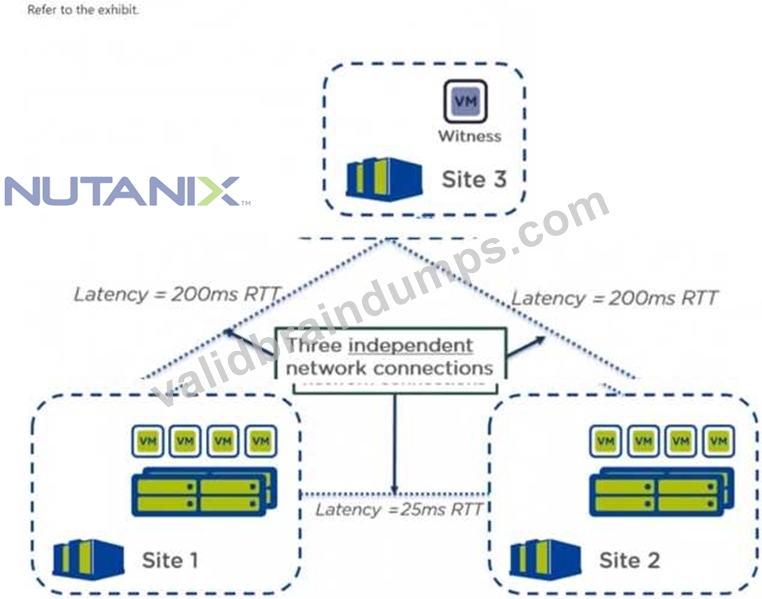
An administrator is configuring Metro Availability in their environment, as shown in the diagram. What issue in the configuration will prevent Metro from working correctly?
- A. The latency between Site 1 and Site 2 is too high.
- B. The Witness VM is located in a third site.
- C. The latency from the Witness VM to both Site 1 and 2 is too high.
- D. Each site should have a Witness VM.
Answer: A
NEW QUESTION # 68
After an unplanned outage, all VMs were successfully failed over to the recovery site, and users are now accessing workloads from there. The DR dashboard shows the failover is complete and replication from the original primary site has stopped.
As part of post-failover cleanup, what is the most appropriate next action to ensure the DR configuration reflects the current production state and is ready for future protection?
- A. Delete all existing recovery points to prevent data inconsistency.
- B. Re-protect workloads so that the current production site is protected.
- C. Leave the environment as-is since workloads are functioning normally.
- D. Immediately initiate another failover to restore the original configuration.
Answer: B
NEW QUESTION # 69
An administrator initiates an unplanned failover due to a primary AZ outage.
What is the worst-case scenario for data loss and which recovery point will be used by default?
- A. Maximum data loss is always zero, and the system uses the most recent recovery point by default.
- B. Maximum data loss equals the RPO in the protection policy, VMs recover from the most recent recovery point.
- C. Maximum data loss equals the longest RPO, and the administrator must always manually select a recovery point.
- D. Data loss depends only on recovery plan, and the system uses recovery points at the recovery AZ by default.
Answer: B
NEW QUESTION # 70
A Protection Policy is configured with a Nearsync replication schedule (15-minute RPO). An administrator observes that the system has temporarily transitioned to an hourly replication schedule.
Which scenario would cause this automatic transition from Nearsync to Asynchronous (hourly) replication?
- A. A new VM was added to the protection category, triggering a full initial sync.
- B. The Nutanix Cloud Infrastructure license expired.
- C. A Test Failover operation is currently running on the recovery site.
- D. The bandwidth is insufficient for the change rate.
Answer: A
NEW QUESTION # 71
A Veeam backup job is configured to use Nutanix application-consistent snapshots for several Windows VMs. Crash-consistent snapshots succeed, but Veeam reports that application-consistent snapshots fail with errors related to VSS processing.
Upon investigation, the administrator confirms:
The VMs are powered on.
Network connectivity between the backup server and cluster is healthy.
Which configuration should the administrator verify to resolve the issue?
- A. Increase the snapshot retention count.
- B. Enable incremental backups on the VMs.
- C. Configure synchronous replication.
- D. Ensure NGT is installed on the VMs.
Answer: D
NEW QUESTION # 72
An administrator recently expanded a Nutanix cluster by adding several new nodes. Shortly after, multiple backup jobs began failing.
The following error is consistently reported:
Failed to perform backup: Cannot complete process 'iscsiadm --mode discovery --type sendtargets --portal X.X.X.X' within timeout What is the most likely cause of the failure?
- A. Firewall ports 3502 and 3620 are missing to the new nodes.
- B. Firewall ports 3205 and 3260 are missing to the new nodes.
- C. Firewall ports 3302 and 3360 are missing to the new nodes.
- D. Firewall ports 3202 and 3206 are missing to the new nodes.
Answer: B
NEW QUESTION # 73
An administrator intends to configure a NearSync replication schedule with a 15-minute Recovery Point Objective (RPO) on a hybrid 3-node cluster. The current nodes in the cluster are configured with one SSD and four HDDs each.
Which cost-effective modification is required to support this specific replication schedule?
- A. Configure the cluster with a minimum of four nodes.
- B. Replace the HDDs with NVMe drives to support the IOPS requirement.
- C. Increase the Controller VM (CVM) memory to 64 GB.
- D. Add a second SSD to each node to meet the minimum requirement.
Answer: B
NEW QUESTION # 74
An administrator executes a Recovery Plan for a set of high-performance VMs configured with SR-IOV network adapters. The VMs failover successfully to the Recovery Cluster.
What is the state of these VMs immediately after the planned failover completes?
- A. The VMs are recovered in a powered-off state, and the SR-IOV profile is removed.
- B. The VMs are powered on, and SR-IOV is active.
- C. The failover fails during the validation phase because SR-IOV VMs cannot be protected.
- D. The VMs are powered on, but SR-IOV is disabled and replaced with a standard virtio-net adapter.
Answer: D
NEW QUESTION # 75
......
NCP-BC Dumps for success in Actual Exam: https://examsboost.validbraindumps.com/NCP-BC-exam-prep.html